


When we dive into work with a new team, there's one thing employees almost always tell us they want more of. It's not fancier benefits, or even a raise; it's clarity on what getting ahead actually looks like. They want to know what’s next in their career, and what it takes to get there.
We hear this from nonprofits trying to retain mission-driven program staff. We hear it from tech startups where everyone got hired quickly and landed where they landed. We hear it from scaling companies that have outgrown their more informal systems. While the context might differ, the human need doesn’t: people want clarity on what they’re growing towards.
Career paths are also our #1 recommendation for equitable work. Far more impactful than a one-time inclusion training or a skimmed-once handbook policy, it directly impacts how hiring, performance, advancement and comp decisions get made, centering an objective, transparent approach.
Why bother designing career paths when we're busy/scrappy?
From the outside, sitting down and building a career framework can look like a lot of work, and we won't lie; done correctly, it is. And in the early days, it feels like overkill; the hire who joins a 3-person startup isn’t usually the type to ask for a formal career path. But as you grow (especially if you’ve passed the 20-person mark), a lack of direction will slow you down- you need to codify and scale what you expect of people. Some specific ways career paths can give you a boost:
People are on the same page: When we all know what good looks like, we’re rowing together. Productivity goes up.
It boosts motivation: When someone can see the next rung clearly and understand what it takes to get there, their work feels like it's leading somewhere meaningful.
Growth and feedback are easier: Performance reviews, feedback, and growth conversations have a common frame of reference.
It improves retention: Employees who can see a path forward are far less likely to go looking for one elsewhere.
Promotions (and pay) are clearer: Career paths make role and comp changes both more consistent and more defensible.
It makes hiring easier: A director at another company might not have the same skills you expect from one; having clear career paths helps you define and evaluate, specifically, what you’re looking for.
It reinforces your values: The Bright + Early way of approaching career paths always starts with an introspective look at what you value, and the behaviours you want to encourage, reward, and lead with. When success (and getting ahead) align with those, and not just output, staff can see that you're walking the walk, and those values are less likely to slip.
It makes things equitable: When there are clear standards to refer back to, bias is less likely to be a factor.
Most organizations start with figuring out levels and titles on the fly, or working from a basic template they found online- one that doesn’t really reflect the way they work, and usually ends up neglected in a drawer. This guide is something different: a practical, step-by-step playbook you can use to make your own values-driven career paths, built from how we do this work every day.
Getting this right takes real time. Realistically, you are looking at a couple of months of thoughtful, collaborative work with your entire leadership team. This is not a plug-it-into-an-AI exercise, though there are areas where it can be helpful (we'll call those out as we go).
What you'll have at the end:
Org-wide job levels and expectations. Department-specific career paths. Values embedded in how people grow and advance. A framework connected to hiring, compensation, and performance. A rollout plan your team will actually use. Let’s do it!
Step 1: Define your core competencies
What does good actually look like here?
Before you touch a spreadsheet, you need to get honest about what your organization genuinely values. Not the polished version on your website: the real thing. What behaviours help people thrive here? What gets someone promoted? What makes someone not a fit, even if they have the right technical skills?
Core competencies are not job skills, like knowing Excel or a specific programming language (we’ll get to those later). They’re the underlying behaviours and capabilities that give your organization a competitive edge, or that reinforce your mission. The expectation, as people get more senior, is that they apply each in a more sophisticated or impactful way.
The Bright + Early Way: Start With Values
To build your org-wide competencies, we recommend starting with your core values and considering how they show up in action. What does someone who truly embodies your culture do at an entry level versus a leadership level?
A nonprofit built around community voice should be able to describe what that means for a program coordinator versus an executive director. A tech company that values psychological safety should be able to describe how that shows up differently for an engineer versus an engineering director.
Let's use the example of MerryGoRound, an innovative company disrupting the ice cream sector with new technology. Their values are:
No Chill: We get it done, and we get it done fast.
All About The Ice: We keep a laser focus on profitability.
Never Vanilla: We are creative and think outside of the box.
Be Sweet: We treat each other with respect, generosity, and actual human warmth, even when things are melting down.
Pass It Around: We show up for our communities, not just our customers.
Here, each value becomes an anchor for a cluster of core competencies. These are the behaviours you will evaluate at every level of your organization, and that will live in every department path you build. Here are MerryGoRound’s core competencies, aligned to each value:
No Chill:
- Initiative: At MerryGoRound, waiting to be told what to do is not the move. Initiative means spotting what needs to happen and moving on it.
- Ownership: This means not just completing tasks but caring whether the result is good, following through when things get complicated, and not passing the problem to someone else.
- Execution: Whether someone actually delivers, consistently, at the standard the team expects. It’s the difference between someone who means well and someone you can count on.
All About The Ice:
- Data-driven mindset: Making decisions grounded in evidence rather than instinct or habit. At MerryGoRound, protecting profitability requires everyone to understand the numbers behind their work, not just the outputs.
- Resource management: How someone handles time, budget, and capacity.
- Prioritization: When everything feels urgent, the ability to identify what actually moves the needle is a superpower. This competency reflects the discipline to say no to the good things so you can say yes to the right things.
Never Vanilla:
- Creative problem-solving: This isn’t about being artistic; it is about refusing to default to the obvious answer. This competency captures whether someone brings genuine originality to the problems in front of them, especially when the obvious approach is not working.
- Strategy: Whether someone can translate a fresh idea into a plan that actually works, and connect creative thinking to real outcomes.
- Growth mindset: Thinking outside the box requires believing that the box can be moved. A growth mindset means staying curious, treating mistakes as information, and actively seeking to get better.
Be Sweet:
- Collaboration: Be Sweet is most visible when things are hard. Collaboration here is not just about working alongside people; it is about whether someone makes the team stronger, especially under pressure. Do they share credit? Do they pull people together or create friction?
- Communication: Clarity is kindness, and good communication means people leave conversations feeling both informed and respected, with the context (and feedback) they need to do a good job.
- Teamwork mindset: Assuming good intent, putting the team's success above your own, and making it easier for others to do their best work.
Pass It Around:
- Community engagement: Willingness to invest time and energy in the people and places the organization serves, beyond the transactional.
- Relationship building Whether someone invests in genuine, long-term connections with teammates, community members, and collaborators.
- Impact mindset: Consistently asking: who does this affect, and are we making things better for them?
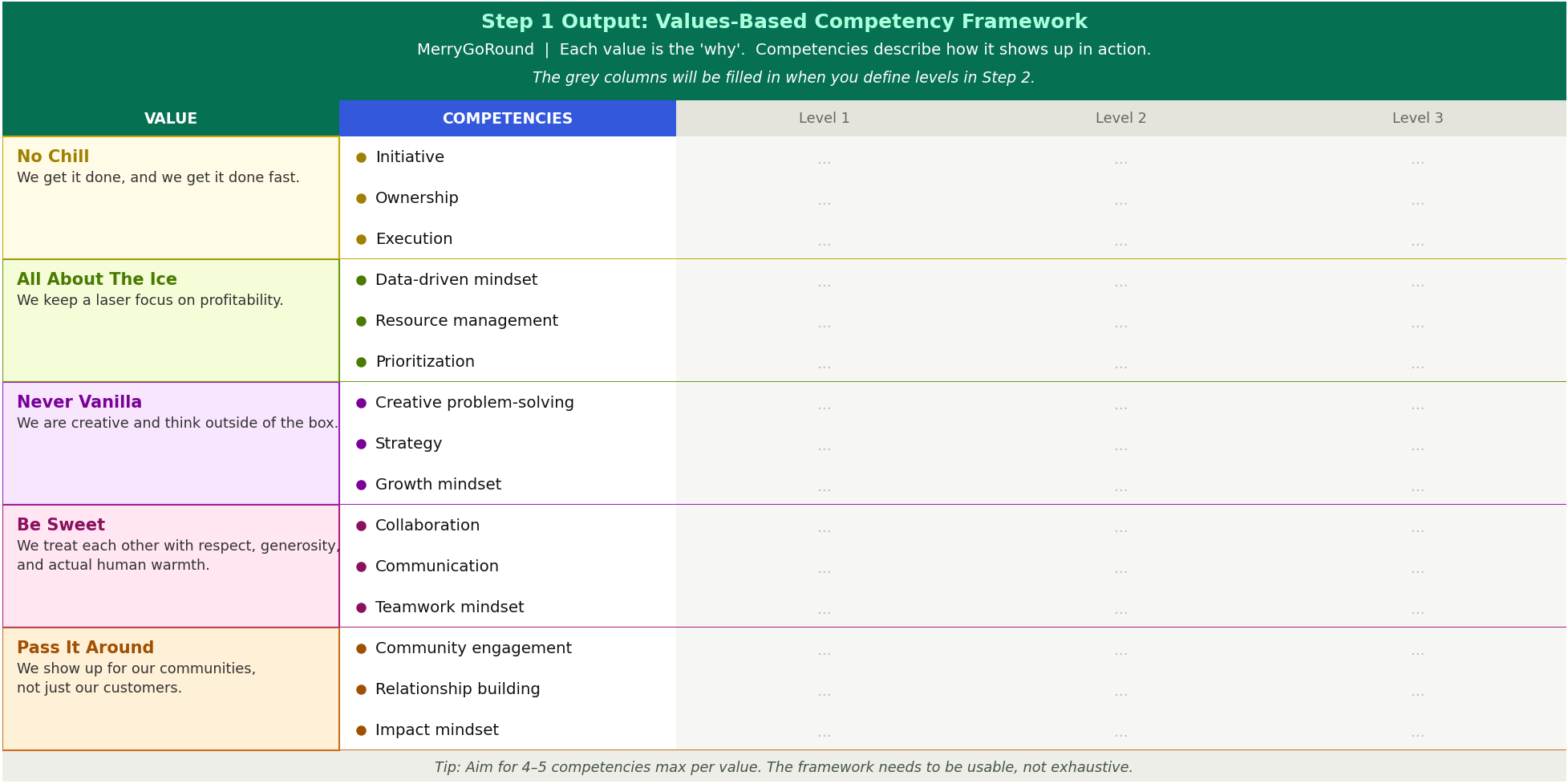
Figure 1: After Step 1, your matrix has values and competencies defined on the left. Levels will be added in Step 2.
Workshop Session: What You Really Value
To drive further into developing your own competencies out of what you value, have a structured conversation where you explore the following lenses. For this activity, we suggest involving all key members of the leadership team, as well as the team leading the project.
Promotion Lens: Think of a recent promotion that felt like a natural decision. Why did that person get promoted? What behaviours or competencies drove the decision? If your values were truly a factor, which ones showed up and how?
Offboarding Lens: Think of a time you had to let someone go. What were they missing? Was it a skills gap, a values misalignment, or both? What did it reveal about what this team actually needs?
Great Hire Lens: Think of a hire who exceeded all expectations. What made them stand out? Was it a behaviour, an attitude, a specific skill, or how they approached their work? How did they embody the culture?
Values Reality Check: If someone observed your team for two weeks, would they be able to identify your values from what they saw, not what was written down? Where do your stated values show up most clearly in how people work? Where is the gap between the aspiration and the reality?
Growth Lens: Think about someone who has grown the most on your team in the last year. What changed in how they showed up? What did they stop doing? What did they start doing? Which of those changes would you want others to replicate?
Leadership Lens: Who on your team would you most want to clone? Not because of their output alone, but because of how they operate. What specifically do they do that you want to see more of across the organization?
USING AI FOR THIS STEP:
For this step, don't skip the meaningful, live conversation about how values show up in action. This is the core of the work. If you want to use AI in this step, it might be helpful in suggesting or drafting competencies that will live under each of your values. This will work best if you input clear notes from your workshop session, descriptive documentation on your values, clear directions, and good context about your organization as a whole. Remember to review any output carefully and course-correct before moving on to the next step.
Step 2: Define the levels
Define the rungs before you build the ladder.
Once your organization-wide competencies are clear, define how they show up at each level.
Most organizations land on six levels: Entry (or junior), Developing (intermediate), Skilled IC (Individual Contributor) or Manager, Director, VP, and C-Suite. Your structure may look different. Smaller nonprofits often have fewer levels. Larger tech companies sometimes have more.
Generally, you should avoid designing career paths where managing others is the only way to advance. Individual contributor (IC) tracks should run parallel to management tracks. This is especially important for technical roles in tech companies and for specialist roles in nonprofits, where forcing strong contributors into management just to grow them often means both losing a great individual contributor and creating a mediocre manager.
The IC track rewards depth, while the management track rewards building others; both are equally valuable.
At this stage, keep everything generic. You are defining what a director means at your organization, not what a Director of Marketing or a Director of Programs does specifically. That comes in Step 4.
What does each level actually look like?
Adapt this to your reality, but here’s a starting point. Again, you might not have (or need) all of these levels, if you’re smaller.
Entry/Junior
- Focused on learning and executing
- Follows established processes
- Owns clearly defined tasks or small projects
- Seeks feedback frequently and uses it
- Requires regular guidance and check-ins
Developing/Intermediate
- Executes most of their standard work with minimal oversight
- Identifies problems and brings some recommendations, not just questions
- Collaborates across departments and areas when needed
- Begins supporting more junior teammates
Skilled IC
- Solid contributor, doesn’t need oversight unless new to a task
- Shapes how things are done through their experience and expertise
- Applies the organization's values and vision through their decision-making
- Mentors informally; junior people seek them out
- Proactively identifies issues and proposes/builds systems and fixes
Skilled Manager
- Builds and coaches others
- Guides work execution and holds the quality bar for the team
- Coaches team members on growth and development, not just performance
- Leads with empathy, inspires high engagement
- Addresses performance issues early
Director IC
- Leads a core function without direct people management
- Operationalizes technical strategy across the org
- Raises the quality bar overall in their area
- Mentors senior talent
Department Director
- Builds high-performing teams
- Develops managers into strong leaders
- Aligns departmental goals to the mission, strategy, and values
- Responsible for their department’s performance, health, and culture
VP
- Oversees major areas of the business end-to-end
- Has a proven track record of building and scaling high-performing teams
- Formulates strategy, not just executes it
- Develops a strong director-level bench below them
C-Suite
- Sets and forecasts strategic direction
- Makes decisions that impact scale and sustainability
- Establishes company-wide goals
- Guardian of the culture while building for growth
Once you have your levels mapped, add them to the top row of your matrix. Your competencies are on the left, your levels are across the top. Now comes the part that takes the most thought: filling in what each core competency (from step 1) looks like at each level.
The goal for each cell is a description specific enough that two managers would apply it the same way to the same person. If it is vague enough to mean anything, it won’t work.
A few things that might help:
Make each level meaningfully different from the one before it. Read two adjacent levels in the same row out loud. The shift from one level to the next should describe a real change in scope, judgment, or independence.
Use your own people as a calibration tool. Think of someone on your team who clearly embodies this competency at this level. Write the description with them in mind, then check: would it also describe someone a level below them? If yes, raise the bar. Would it describe almost no one? Loosen it a bit.
Watch for language that sounds good but measures nothing. Phrases like "demonstrates strong leadership" or "communicates effectively" aren’t really possible to evaluate consistently. Push for specifics: what does strong leadership look like in a meeting? What does effective communication produce? The more concrete the language, the more useful the framework becomes in practice.
Start with the middle levels first. Entry and director are often easier to write because the contrast is obvious. The Developing and Skilled levels are where most teams get stuck, because the difference is subtle. If you find yourself writing nearly identical cells for two adjacent levels, that is a signal that you may not need both levels, or that the competency needs to be reframed to show a clearer progression.
Figure 2 shows what this looks like filled in for MerryGoRound, using the values-based competencies defined in Step 1.
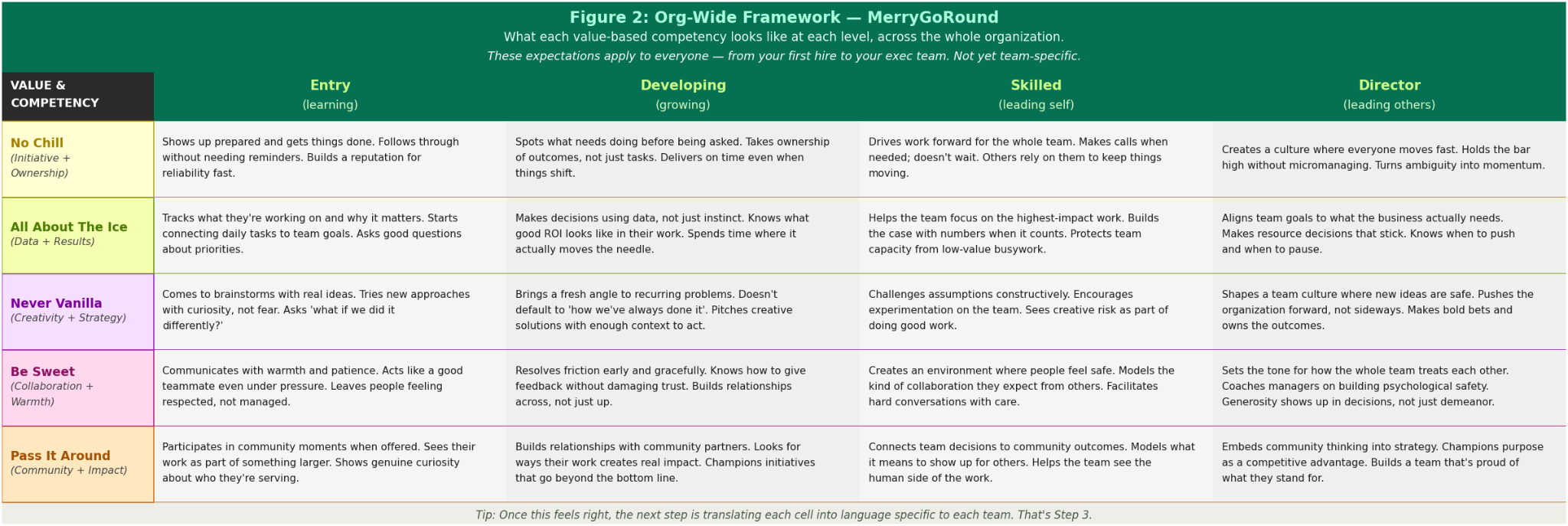
Figure 2: After Step 2, levels are added to the top row, and general expectations fill the matrix. Not yet department-specific.
USING AI FOR THIS STEP:
Don't use AI to decide your levels; you should be describing the reality of your organization. If you have strong job descriptions for all roles, it could be helpful to input them, compare them, and see if you're currently defining success similarly at the same level across different departments. AI could also be used for a first draft of how your new competencies might apply to each level, but this should be reviewed and corrected to reflect your reality.
Step 3: Build department-specific career paths
From org-wide framework to team-specific paths.
With your competencies and levels defined, it's time to make the framework specific to each team.
For a nonprofit, this might mean separate paths for program delivery, fundraising, and operations. For a tech company, it might mean engineering, product, design, and marketing. The levels stay consistent across every department. The behaviours, expectations, and skills get specific to each team.
Note: Some early or small organizations may choose to start with organization-wide levels and leave it at that for now. If that's you, it's perfectly fine to skip this step and return to it when needed.
Start with your managers
Before writing role-specific career paths on your own, sit down with the leaders of each department. These conversations are where the general framework gets translated into something more tangible, usable, and trusted by the people who will actually apply it. They’ll also increase buy-in from those managers, and surface mismatches between where people are and where the role needs them to be, which is information you need before you start placing anyone in the levels.
Come prepared with the following questions:
- Role and current responsibilities: What is the role actually doing day-to-day? Not what the job description says. What does the work really look like?
- Responsibilities and accountability: What are the key accountabilities for each person? What are they responsible for?
- Relationships and impact: Who does this role work with most, inside and outside the team? Who does their work impact?
- Current goals: What are each person's current goals? What are they working toward right now?
- Job alignment: Is the work they are doing actually aligned with what the role was designed to be? If not, that’s important to name.
- How they define success: How does this manager define success and growth in this role? What does doing well here actually look like to them?
- Team growth plans: What is the team growth plan? What roles might be needed in the next 12 to 24 months?
- How they see the team growing: How do they see the team evolving as the organization scales?
- Current gaps: Where are the current gaps on the team relative to company goals? What is missing?
These conversations will surface the specific skills that need to live in the department path, things that don't belong in the org-wide framework but are central to how this team works. Hold on to those; they become your skills-based competencies later on.
Write the career path
Now you're ready to put pen to paper. In the Bright + Early way, each department path has two layers.
The first layer takes the org-wide values and competencies and translates them into language that is specific to how this team works. What does No Chill look like for a Marketing Coordinator versus a Marketing Director? What does Be Sweet look like for someone in a client-facing role versus a technical one?
The second layer adds skills-based competencies: the technical capabilities that define what someone in this function actually does well. These don't live in the org-wide framework because they're specific to the role. For a marketing team, that might mean campaign strategy, content and brand, performance reporting, or vendor management. For a program team at a nonprofit, it might mean community facilitation, grant writing, or impact measurement. Each skill competency is defined at every level from entry to director.
Values-based competencies:
For each value competency, describe what living that value looks like in the day-to-day of this specific role. The same value will look different for a program coordinator than it does for a fundraising director, or for a junior engineer versus an engineering director.
Skills-based competencies:
For each technical skill area identified in your manager conversations, describe what doing it well looks like at this level. Keep each description to one or two sentences. It should be specific enough to use in a hiring brief or a performance review.
Once your paths are built, you will fill in the columns of your matrix with department-specific expectations. The structure stays the same as the general framework. The language becomes specific to each team/role.
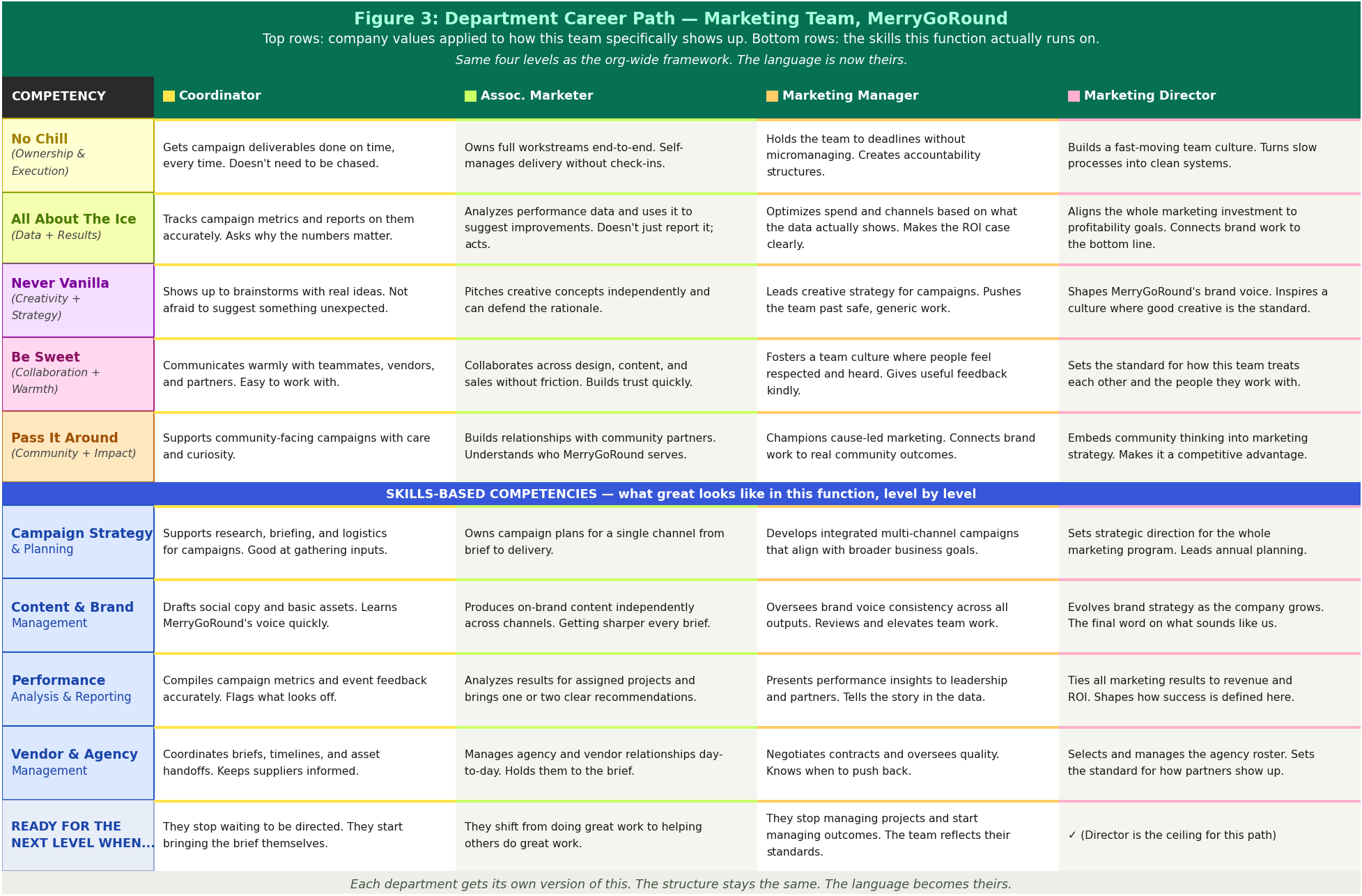
Figure 3: After Step 3, the same matrix is filled in for the Marketing team at MerryGoRound. The top rows show the value competencies applied to this team; the bottom rows show skills-based competencies specific to marketing.
USING AI FOR THIS STEP:
These conversations generate a lot of qualitative input quickly. Once you have notes from your manager sessions, AI can help you synthesize themes and draft a first pass of the skills-based competencies. Try: 'Here are my notes from conversations with our Marketing team. Based on these, draft skills-based competency definitions for four to five areas across four levels. Keep each cell to one or two sentences.' Review and correct before using.
You can also use AI to gap-check existing job descriptions: 'Do the responsibilities here map cleanly to these four levels? Where are the gaps or overlaps?' One caution: AI will write confident-sounding language that may not reflect your team's reality. Pressure-test everything it produces against the people you know in the roles.
Step 4: Assign employees to paths
Place everyone (carefully).
Now, each department leader assigns every team member a level. This placement impacts all future performance conversations and compensation decisions, and shouldn’t be taken lightly.
For some employees, this may feel like a promotion. For others, it might mean a recalibration, where the work they have been doing doesn’t quite match their current title or their own perception of their seniority. Your communication needs to make clear that this exercise is about creating clarity on what currently is, and not about promoting, rewarding or penalizing anyone.
For each team member, work through:
- The role and what they are actually doing day-to-day, not what the job description says
- Their responsibilities and key accountabilities
- Who they work with and who they impact most
- Their current goals
- Whether the work they are doing is aligned with what the role is meant to be
Steal this: Calibration questions for placement decisions
What they actually do: Describe their current role based on what you observe, not the job description. Are they operating in scope, above it, or below it? Be specific about the kinds of decisions they make and the level of guidance they need.
Scope of impact: Is their influence felt at the task level, the team level, the department, or across the organization? The scope of impact is one of the clearest signals of the level. A developer solving problems for themselves is not at the same level as one who is unblocking the whole team.
Values alignment: Are they living the organization's values at the level expected for someone in this role? If someone has the technical skills but consistently falls short on values alignment, that is a placement and development signal worth naming.
Alignment check: Does the work they are doing align with what the role is meant to be? If not, is this a placement issue, a hiring gap, or a growth opportunity that needs to be explicitly named and supported?
Once placement decisions are made, training is key. Managers and employees both need to understand how the system works, what each level represents, and how movement happens. Without this step, even the best-designed framework can fall apart under scrutiny.
USING AI FOR THIS STEP:
Calibration conversations can surface a lot of qualitative data quickly. If you are calibrating a large team, try pasting anonymized calibration notes into an AI tool and asking: 'What patterns do you see across these placements? Are there any levels where managers seem to be applying different standards?' This can surface calibration drift before it becomes a fairness problem. AI should not make placement decisions, but it can help you see patterns in the data more clearly.
Step 5: Roll it out
A great framework falls flat without a great launch.
The way you communicate this matters as much as the work itself. Employees will have questions, concerns, and maybe some strong feelings. That's okay, and it is a sign that the work is meaningful to them. Clear communication and consistent messaging are important here.
Coach managers first: Before anything goes to the full team, managers need to deeply understand the framework and feel confident answering questions about it. Run dedicated training sessions. They should be able to explain why the framework exists, how placement decisions were made, and what the path forward looks like for each person.
All-hands presentation: Leadership presents the framework: what it is, why it exists, and how it supports growth. Keep it high-level. Details come in one-on-ones.
One-on-one conversations with every employee: Department leaders and managers meet individually with each direct report to share their placement and what it means for their growth. No one should find out their level in a group setting.
Explain the pay connection: Be transparent: how do levels connect to pay bands? What does progression look like over time? Uncertainty around compensation breeds distrust faster than almost anything else. Not sure how to connect these? Check out our Guide to Paying People.
Create a performance playbook: Document how this system works year-round: goal setting, review rubrics, cadence. This is what gets career paths out of Google Drive and into daily work.
Frame it as an investment in their growth. Because it is!
USING AI FOR THIS STEP
AI can help you prepare managers for the rollout conversations. Try prompting: 'Here is our career framework, and here is a sample placement decision. What questions might an employee ask when they hear this, and how should a manager respond?' Run through a few scenarios before the real conversations happen.
You can also use AI to draft the all-hands talking points, the manager conversation guide, and the employee FAQ. Give it the framework, tell it the audience, and ask for a first draft. You will still need to edit for voice and accuracy, but it removes the blank-page problem.
After rollout, use AI to analyze employee survey responses about the framework. Paste anonymized feedback and ask it to group themes and identify the top concerns. This helps you prioritize what to address first.
Step 6: Connect
Your new career paths shouldn’t exist in a vacuum- they’re the centre to a well-designed people framework. Once you have solid paths in place, you can connect them to:
Hiring: Your career paths should be the source of truth for every job description you write. When a hiring manager sits down to describe a role, they should be pulling directly from the level expectations you have already defined, not writing from scratch or copying a template from the internet. Your interview processes should reflect your core competencies (for all roles) and the level and department specific ones for each respective role.
Onboarding: Career paths can help level-set with a new hire what the path forward looks like, and what’s expected.
Performance and feedback: Managers should be using the paths as an aid in feedback, or in career growth conversations. Your paths should also be the core base of your performance reviews. In practice, performance reviews should be structured around the competency framework at the person's current level. For each competency, the manager and employee both assess: is this person consistently meeting the expectation, developing toward it, or exceeding it and starting to operate at the next level? That last category (consistently exceeding) is what triggers a promotion conversation, not tenure or likeability.
The review process should also explicitly evaluate values alignment, not just skills. If your framework includes values-based competencies (the Bright + Early way!), then every performance review is also a check on whether people are actually living the values, not just delivering results. This is what makes culture measurable vs aspirational.
For organizations using a 360 feedback process, the career path competencies should be the structure for peer feedback as well. Instead of open-ended questions about what someone should start, stop, and continue doing, peers respond to specific competency prompts: where does this person show strong ownership? Where do you see them holding back? This makes feedback more specific, more consistent, and significantly more useful for development.
Compensation: Pay bands should be anchored to levels, not to titles or tenure or how well someone negotiated when they were hired. When compensation is level-based, it becomes equitable, transparent, and defensible. Managers can explain pay decisions clearly. Employees understand what drives progression. And the organization avoids the compounding inequities that come from ad hoc salary decisions made in isolation over years.
For practical guidance on building pay bands and connecting them to your levels, our Guide to Paying People walks through this process in full. The short version: define a salary range for each level (not each role) based on market data and internal equity, and use the career path level as the anchor for every compensation decision going forward.
Good career paths serve two big purposes. They’re an act of care for staff; you’ve sat down, thought seriously about their growth, and made a commitment to investing in it. They’re also an act of clarity. You’ve defined what high performance actually looks like, and what it takes to get there. Getting both right is what makes your team somewhere people genuinely want to grow.
Happy Building,
Team Bright + Early
WANT A HAND WITH THIS?
If you’d like hands-on help designing (and launching) career paths that actually fit how you work, send us a note at hello@brightandearly.ca.
